One Spice, Three Continents: Cooking Hungarian Goulash, Spanish Patatas Bravas, and Turkish Muhammara at Home
Paprika is one of those ingredients that feels simultaneously universal and deeply personal to the cultures that claim it. Ask a Hungarian grandmother, a Catalan home cook, and a Turkish chef what paprika is for, and you'll get three completely different answers — each of them correct.
That's the thing about this spice. It isn't a one-trick seasoning. Depending on where you are in the world, paprika is the backbone of a slow-braised stew, the soul of a fried potato dish with serious attitude, or the star of a smoky, nutty spread that makes everything it touches taste more interesting. Learning to cook with paprika across these three traditions doesn't just expand your recipe repertoire — it fundamentally changes how you think about seasoning.
Let's take a trip. No passport required.
Hungary: Goulash That Actually Tastes Like Something
The cultural context
Hungarian goulash — gulyás in its home country — is one of the most misunderstood dishes in American kitchens. What gets sold here as "goulash" is often a pasta-and-ground-beef situation that would be unrecognizable to anyone from Debrecen. Real goulash is a paprika-forward beef and vegetable stew, closer to a rich soup than a thick braise, and paprika isn't a supporting player — it's the entire point.
Hungary produces some of the world's finest paprika, particularly from the Kalocsa and Szeged regions, and Hungarian cooking uses it in quantities that might make American home cooks nervous. Don't be nervous. Lean in.
The recipe
Serves 4–6 | Time: About 2 hours
Ingredients:
- 2 lbs beef chuck, cut into 1.5-inch cubes
- 3 tbsp lard or neutral oil
- 2 large yellow onions, diced
- 3 tbsp sweet Hungarian paprika
- 1 tsp caraway seeds
- 3 garlic cloves, minced
- 2 tbsp tomato paste
- 1 large red bell pepper, diced
- 3 medium Yukon Gold potatoes, cut into chunks
- 4 cups beef broth
- Salt and black pepper
- Fresh marjoram or flat-leaf parsley to finish
Method:
Pat the beef dry and season generously with salt and pepper. In a large Dutch oven, brown the beef in batches in the lard or oil over medium-high heat. Don't crowd the pan — you want a deep sear, not steaming. Set the beef aside.
Reduce heat to medium. Add the onions to the same pot and cook, stirring occasionally, until they're deeply golden and soft — about 15 minutes. This step matters. Properly cooked onions are the foundation here.
Pull the pot off the heat briefly. Add the paprika and caraway seeds to the onions and stir vigorously for 30 seconds — the residual heat blooms the spice without burning it. Return to medium heat, add the garlic and tomato paste, and cook another minute.
Add the beef back in along with the bell pepper and broth. Bring to a simmer, cover, and cook for 1 hour. Add the potatoes and continue cooking, uncovered, for another 30 to 40 minutes until the beef is completely tender and the broth has thickened slightly.
Finish with fresh marjoram or parsley. Serve with crusty bread or egg noodles.
The technique note: Pulling the pot off heat before adding paprika is a classic Hungarian move — it prevents the spice from scorching in a dry pan while still allowing it to bloom in the residual fat.
Spain: Patatas Bravas With Real Bite
The cultural context
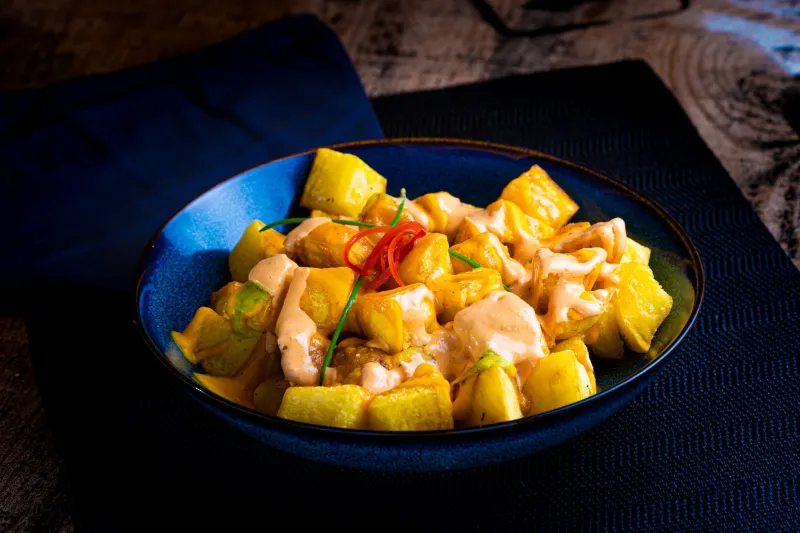
Patatas bravas are a fixture of Spanish tapas culture — crispy fried potatoes served with a sauce that's supposed to have genuine heat and smoke. The name bravas literally translates to "fierce" or "brave," which tells you something about the intended experience.
The Spanish paprika used in bravas sauce is typically pimentón de la Vera, a smoked variety from the Extremadura region that's dried over oak fires. It comes in sweet (dulce), bittersweet (agridulce), and hot (picante) varieties. For bravas, you want a combination of smoked sweet and smoked hot to get both depth and fire.
The recipe
Serves 4 as a side or appetizer | Time: 45 minutes
For the potatoes:
- 2 lbs russet potatoes, cut into rough 1.5-inch chunks
- Olive oil for frying (or roasting)
- Salt
For the bravas sauce:
- 3 tbsp olive oil
- 4 garlic cloves, smashed
- 1.5 tsp smoked sweet pimentón de la Vera
- 1 tsp smoked hot pimentón de la Vera
- 1 tbsp all-purpose flour
- 1 cup chicken or vegetable broth
- 1 tbsp sherry vinegar
- Salt to taste
Method:
For the potatoes: If roasting (the easier home method), toss potato chunks in olive oil and salt, spread on a sheet pan, and roast at 425°F for 35 to 40 minutes, flipping once, until deeply golden and crisp.
For the sauce: Heat olive oil in a small saucepan over medium heat. Add the smashed garlic and cook until lightly golden, about 3 minutes. Remove and discard the garlic. Add both paprikas to the garlic-infused oil and stir for 30 seconds. Whisk in the flour and cook another 30 seconds. Slowly pour in the broth while whisking to prevent lumps. Simmer until the sauce thickens to a consistency that coats a spoon, about 5 minutes. Stir in the sherry vinegar and season with salt.
Spoon sauce generously over the hot potatoes. Serve immediately — these don't wait around.
The technique note: Infusing oil with garlic before adding paprika is a Spanish technique that layers flavor. The garlic leaves behind its aromatics in the fat, which then carries them through the entire sauce along with the paprika.
Turkey: Muhammara — The Spread That Earns Its Place on the Table
The cultural context
Muhammara is a roasted red pepper and walnut spread from Gaziantep, a city in southeastern Turkey known for some of the most complex and spice-forward cooking in the country. It's served as part of a meze spread, used as a sauce for grilled meats, or simply scooped up with flatbread. Once you taste it, you'll understand why it belongs in all three contexts.
The paprika in muhammara is typically a Turkish variety — often pul biber (dried red pepper flakes) or a paste made from dried Aleppo or Maraş peppers — which brings fruity warmth and moderate heat rather than the smokiness of Spanish pimentón or the pure sweetness of Hungarian paprika. If you can't find Turkish pepper flakes, Aleppo pepper is widely available online and at Middle Eastern grocery stores across the US.
The recipe
Makes about 1.5 cups | Time: 25 minutes (plus roasting time)
Ingredients:
- 2 large red bell peppers, roasted (jarred roasted peppers work fine here)
- 1 cup walnuts, lightly toasted
- 2 tbsp olive oil, plus more to finish
- 1.5 tsp Aleppo pepper or Turkish pul biber
- 1 tsp smoked sweet paprika
- 1 tbsp pomegranate molasses
- 1 tbsp lemon juice
- 1 tsp cumin
- Salt to taste
- Optional: 1 tbsp breadcrumbs for thickness
Method:
If roasting your own peppers, char them directly over a gas flame or under a broiler until blackened all over. Transfer to a bowl, cover with plastic wrap, and steam for 10 minutes. Peel, seed, and roughly chop.
In a food processor, combine the roasted peppers, toasted walnuts, Aleppo pepper, smoked paprika, pomegranate molasses, lemon juice, and cumin. Pulse until you get a slightly chunky paste — muhammara should have texture, not be completely smooth. Drizzle in the olive oil with the processor running. Add breadcrumbs if the mixture seems too loose. Season generously with salt.
Transfer to a serving bowl, drizzle with more olive oil, and sprinkle with a pinch of Aleppo pepper. Serve with warm pita or flatbread.
The technique note: Toasting the walnuts before processing is non-negotiable — raw walnuts have a slightly bitter, green flavor that fights with the paprika. Toasted walnuts bring out a buttery depth that makes the whole spread more cohesive.
What These Three Dishes Teach You
Cook all three of these on the same weekend and you'll notice something interesting: you've used paprika in every single one, but they taste nothing alike. That's not a contradiction — it's the whole lesson.
In the goulash, paprika is mass and warmth, built in enormous quantity into the base of a slow stew. In the bravas sauce, it's precision and smoke, used in smaller amounts to season a quick emulsified sauce. In the muhammara, it's brightness and fruit, layered with other bold flavors in a spread that's as complex as anything you'd find in a fine-dining appetizer.
Same spice. Completely different philosophy. That's what it means to cook globally — not just collecting recipes, but understanding what a single ingredient can become in different hands.